Wine Cooler Repair
Wine Storage in a Semi-Arid City: What Denver's Dry Air Actually Does Inside a Sub-Zero Wine Unit
Denver's dry air does not reach inside a sealed Sub-Zero wine cabinet the way owners assume — the evaporator sets interior moisture. What dryness really attacks is the door seal, and a stiff seal is what turns into a unit that never stops running.
Denver is classified as a semi-arid cold steppe — Köppen BSk — and depending on which dataset you read it collects somewhere between about 12.95 and 15 inches of precipitation in a year. That is the number people quote at us when a cork comes out looking wrong. The honest answer is more interesting than the folk version, and it changes what gets repaired.
Here is the part most articles get backwards. The inside of a sealed Sub-Zero wine cabinet is not humidified by the room. Its moisture level is set almost entirely by its own evaporator and how hard that evaporator is working. Denver’s dry air reaches the wine two ways only: through the doorway, every time it opens, and through what dryness does over years to the rubber that seals the doorway shut.
The part of the year that matters
Winter, and not for the reason most owners expect. Outdoor relative humidity in Denver is actually at its highest in the cold months — roughly 61 percent in December and 64 percent in January against about 41 percent in June — but that same air, pulled indoors and heated to living temperature, arrives at the cabinet drier than anything the summer produces.
That is the swing that matters: not outdoor humidity, but indoor humidity after a forced-air furnace has run all day. A Congress Park bungalow with a 1920s footprint and a modern furnace, or a Berkeley half-duplex sealed up tight off Tennyson Street, both spend January exchanging cabinet air for room air that has almost no moisture left in it. Every opening of the door is a small dehumidification event, and in January the events are bigger.
What the swing asks of the machine
It asks the gasket to stay flexible through years of very dry indoor air, and it asks the evaporator to hold a set point while the cabinet is being flushed with dry room air several times an evening.
The gasket is the part that quietly loses. Dry air draws plasticiser out of the seal over time; the rubber stiffens, and a stiff seal takes a set — it remembers the shape it was compressed into and stops springing back. That is not dramatic and nobody notices it happening. What you get is a seal that closes but no longer seals, usually first at the top corner of the hinge side, where a full-height door has the least closing force.
From there the machine behaves exactly as designed. Warm dry air leaks in, the evaporator picks up a load it should not have, run time climbs, and the cabinet gets drier still because a longer-running evaporator condenses more moisture out of the air inside it. Owners describe that as the unit never holding humidity. The unit is holding the humidity its evaporator dictates; the leak is what set the evaporator running.
The failure it produces, and when
Three presentations, in rough order of how often we see them. Corks that recede into the neck or weep at the top on bottles that have been in the cabinet a long time. Labels lifting at the corners. And a unit that reads on set point but runs almost continuously, which shows up on the utility bill before it shows up in the glass.
The diagnostic question underneath all three is one thing: gasket defect, or expected behaviour for a wine cabinet in dry air. It matters because the two have completely different answers. A door that will not hold a strip of paper along its whole length is a repair. A cabinet in a LoDo loft galley that reads correctly, cycles normally, and holds its seal is doing what physics says it should do, and replacing parts will not make it behave like a cave.
Timing is a clue in itself. Complaints that arrive in the deep heating months and quieten down by May generally point at the seal and the room. Complaints that stay level all year, or come with icing inside the cabinet or a zone drifting several degrees off its set point, point at the sealed system, the thermistor or the control instead.
Getting ahead of it
Wipe the gasket down two or three times a year with warm water and nothing stronger — solvents and kitchen sprays accelerate exactly the stiffening you are trying to avoid — and dry it before you close the door.
Test the seal with a strip of paper. Close the door on it, pull it out at ten or twelve points around the perimeter, and compare the drag. One slack section is a finding. Do the same test on the second door of a paired installation; on the Central Park pattern of a wine column beside a butler pantry, the door nobody opens is often the one that has taken a set.
Keep the door open time short and the count low. In a cabinet that is opened forty times during a party, the interior air has been replaced with dry Denver room air over and over, and it needs hours to settle back. And do not fight it with a dish of water in the cabinet — you will get condensation on the coldest surface, not conditioned air.
What we do on the visit
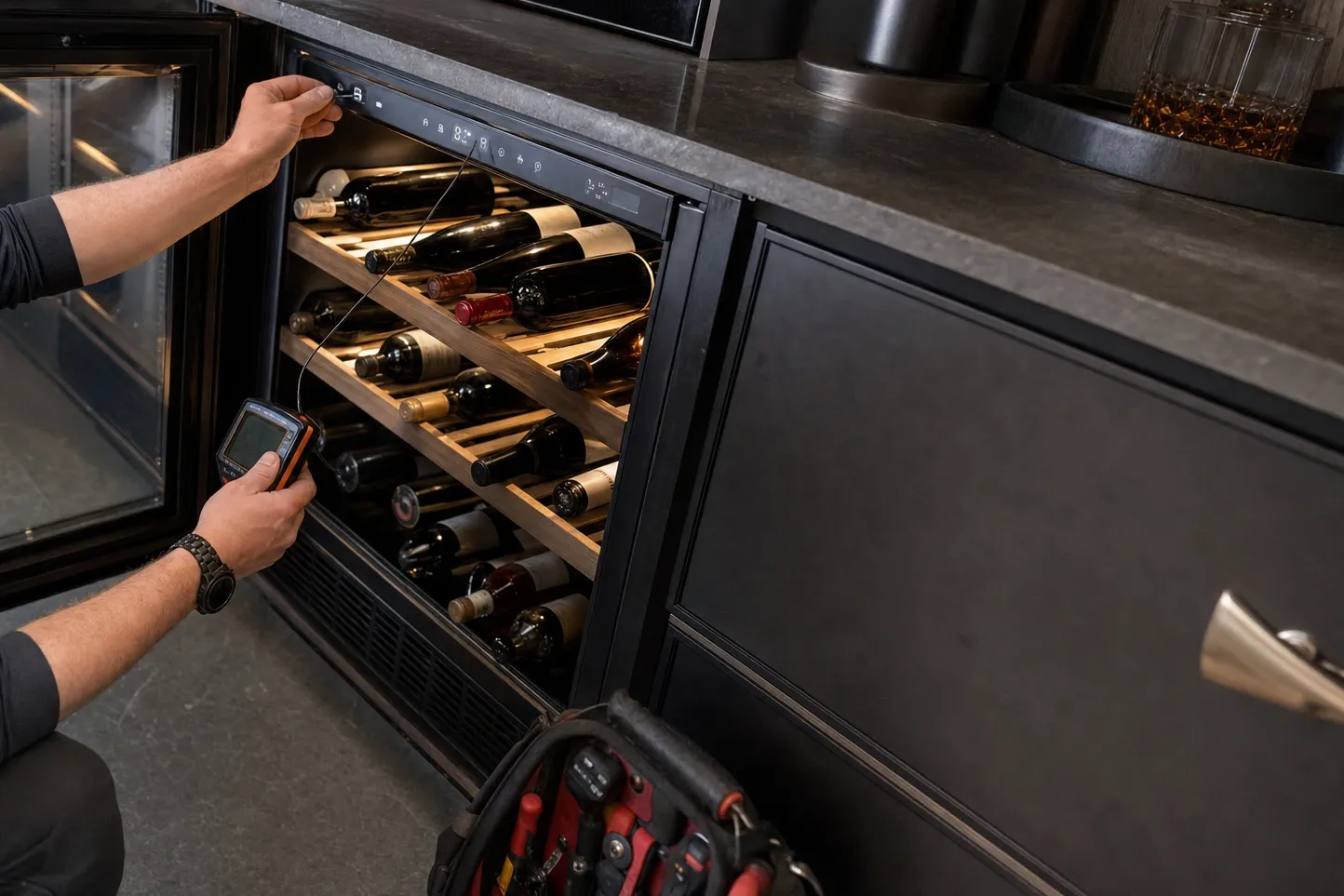
The visit starts at $89 and works in a fixed order: verify the actual cabinet temperature independently of the display, log run time, read the seal at every point around both doors, check hinge alignment and door drop, then look at the evaporator and airflow before anybody talks about parts.
If the answer is the seal, a door gasket or seal replacement runs $280 to $600. A defrost heater, thermostat or sensor is $300 to $600, and an evaporator or condenser fan motor $350 to $670. Where a zone genuinely will not hold and the control is at fault, an electronic control board runs $450 to $930. Sealed-system and compressor work is a different scale of job at $1,410 to $3,070, and it is worth being certain before you go there.
The part of that list we most often end up not selling is the part people call about. (720) 903-2603 reaches the same technician who would take the call.
Follow-ups
Does Denver's dry air lower the humidity inside my wine cabinet?
Barely, and not the way most owners picture it. Interior moisture is governed by the cabinet's own evaporator and how hard it is working, not by the room. Dry Denver air reaches the bottles two ways only: through the doorway each time it opens, and through what years of very dry indoor air do to the door seal.
Why do corks dry out in winter when Denver is more humid then?
Outdoor relative humidity really does climb in the cold months — roughly 61 percent in December and 64 percent in January against about 41 percent in June — but heating that air up to living temperature collapses its relative humidity. The air your cabinet exchanges with at every January door opening is the driest of the whole year.
Is a hum that carries into the room above a fault?
It can be, and it is worth chasing before it grows. Resonance usually means a compressor mount, a fan, or the cabinet passing vibration into the joists rather than a sealed system on its way out. We isolate the source by hand and by stethoscope first. Fan motor work runs $350 to $670; sealed-system repair is $1,410 to $3,070.