Refrigerator Repair
Fresh food side warm, freezer still cold: what your built-in is telling you
On a dual-refrigeration Sub-Zero the two sections are separate machines, so one can fail while the other holds. Here is what causes it, what to check in your own kitchen, and when a Denver call is worth making.
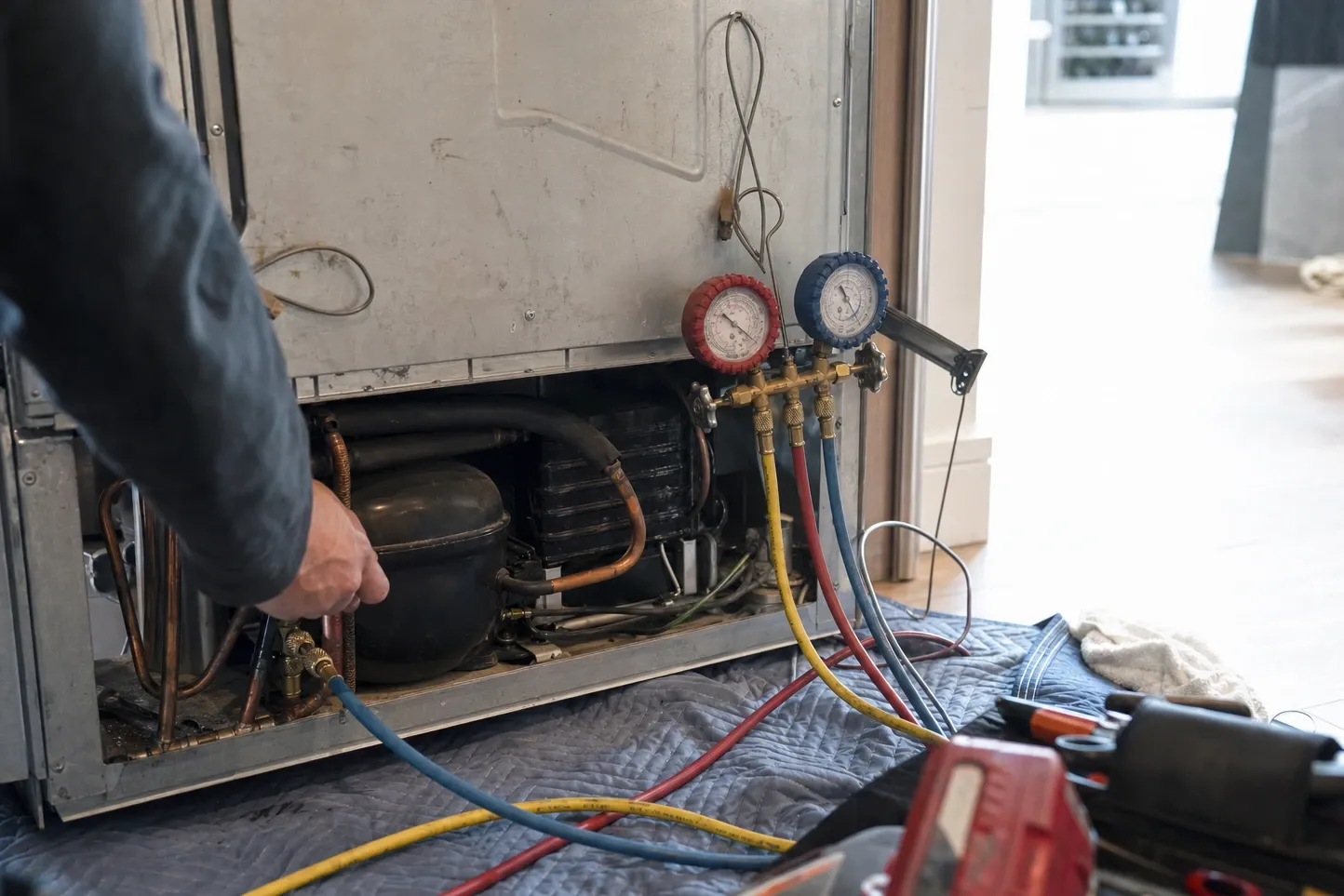
A Sub-Zero that has gone warm on one side and stayed cold on the other is the single most common call we take in Denver, and it is also the one most often misdiagnosed as “the compressor is going”. It almost never is. Understanding why needs one fact about the way these units are built.
Why one half can fail while the other looks fine
A built-in Sub-Zero with two sections is two refrigeration systems sharing a cabinet. That is what dual refrigeration means: the fresh food compartment has its own evaporator coil, its own fan and its own defrost circuit, and so does the freezer. On most models they even have separate compressors. Nothing about a cold freezer tells you anything useful about the fresh food side, because the freezer is a different machine that happens to live in the same box.
So when the fresh food compartment climbs to the high forties or low fifties while the freezer is still hard, the fault is on the fresh food circuit — and there are only a handful of things it can be. That is good news. It means the expensive failure has been ruled out before anyone opens a panel.
The five faults that cause it, in the order we check them
The evaporator fan has stopped or slowed. Cold air has to be pushed off the coil and into the compartment. If the fan seizes, the coil keeps getting cold, the compressor keeps running, and the compartment stays warm. Open the door and listen: on most models you should hear air moving from the vents at the top or back. Silence with the compressor clearly running is a strong signal.
The fresh food evaporator is iced over. Every fridge coil frosts and every fridge coil is defrosted on a cycle. When the defrost heater fails open, or the defrost sensor reads wrong and never calls for a cycle, frost builds until it becomes a solid block and no air can pass through it. This one comes on gradually over a week or two — the section drifts up two degrees, then four, then ten.
The air damper is stuck. Some models feed the fresh food section through a motorised damper. Stuck shut, no cold air arrives; stuck open, the section over-cools and freezes lettuce. Both faults present as “one section is wrong”.
The condenser is matted. This is Denver’s speciality. Cottonwood fluff in June, construction dust in the warehouse conversions, and fine ash after a smoky August week all end up in the same place: the condenser behind the lower grille. A blocked condenser cannot reject heat, so the whole unit runs continuously and the weaker section is the first to lose the argument. It looks like a component failure and it is a housekeeping failure.
The door is not sealing. Air in this city is dry enough to harden a gasket faster than it does at sea level, and a dropped hinge or a hardened corner lets a slow stream of room air in. Warm humid air also feeds the icing problem above, so the two faults often arrive together.
What you can check before calling anyone
Five minutes with a torch will tell you a lot, and none of it requires tools.
- Put a glass of water with a thermometer in it on the middle shelf and read it after four hours. The panel reads the return air, not your food, and the two can differ.
- Pull the lower grille off — it clips or unscrews — and look at the condenser. If you cannot see daylight through the fins, that is your first job, and a vacuum with a brush attachment is the right tool.
- Listen at the fresh food vents with the door open and the light switch pressed in, if your model has one. Air moving means the fan is alive.
- Look at the back wall of the fresh food section behind the crisper drawers. Visible frost, or a rear panel that is cold to the touch and sweating, points at the evaporator.
- Close the door on a strip of paper at three or four points around the frame. If it slides out with no resistance anywhere, the gasket has given up.
If the condenser was filthy and you have cleaned it, give the unit a full day before judging. A cabinet that has been struggling takes hours to pull back down.
What it takes to fix, and roughly how long
An evaporator fan is an hour, and the part is usually on the van. A defrost heater or sensor is a longer job because the rear panel has to come off and the coil has to be thawed properly rather than chipped at — an hour and a half is realistic, longer if the ice has built up for weeks. A damper motor is straightforward once the housing is open. A gasket is quick, but it needs the right one for the model and the door has to be checked for square afterwards, otherwise the new seal fails the same way.
A condenser clean is not a repair at all, and if that is all it needed we will tell you so. The flat $89 service call covers the visit and the diagnosis either way, and it comes off the total if there is a repair to approve.
When it is worth calling someone out
Call when the section is above 40 and staying there, when you can see frost on the back wall, when the unit never cycles off, or when you have cleaned the condenser and it has made no difference after a full day. Those four all point at a part, and parts on these cabinets are worth fitting — the liner, the door and the cabinet are the expensive things, and they outlast everything bolted to them.
Do not call because a section drifted two degrees during a hot spell with the door being opened all afternoon. That is a fridge doing its job in July. Give it a quiet night and read it again in the morning.
Follow-ups
Can I just turn the fresh food side colder to compensate?
It rarely works and it usually makes the diagnosis harder. If the section is warm because its evaporator is iced or its fan has stopped, a lower set point only makes the compressor run longer against a blocked coil. Set it back to 38 and note how long the section takes to drop.
Is a warm fresh food section a refrigerant leak?
Very seldom. A leak normally takes both sections down together, or shows as a freezer that will not get below zero while the fresh food side runs cold. One warm section with a cold freezer points at that section's own fan, defrost circuit or damper first.
How long can I leave it before something is damaged?
The cabinet will not be harmed, but a unit running non-stop against an iced coil wastes electricity and puts hours on a compressor that is otherwise good. Food safety is the real clock — above 40 for more than a couple of hours and the contents are the problem, not the appliance.